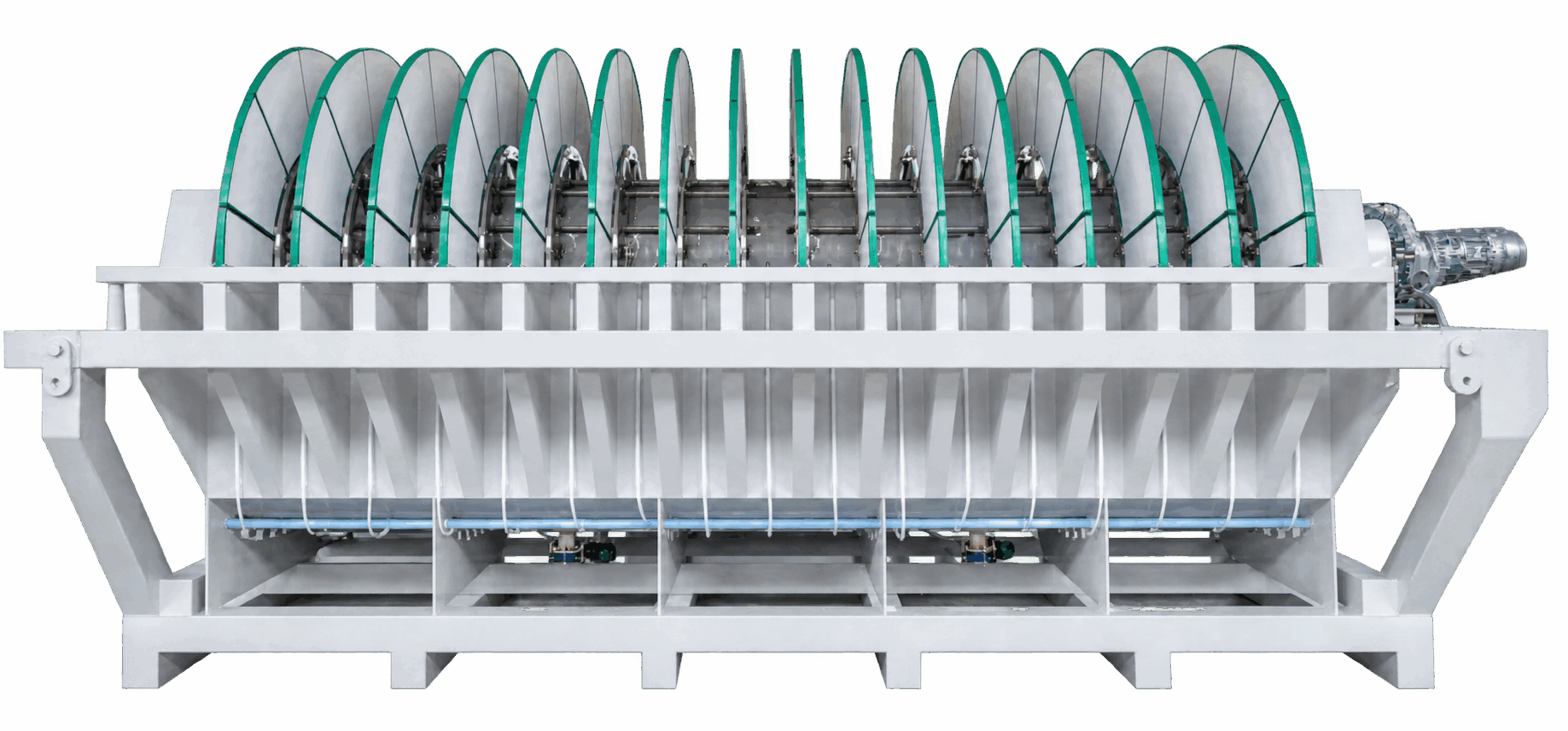
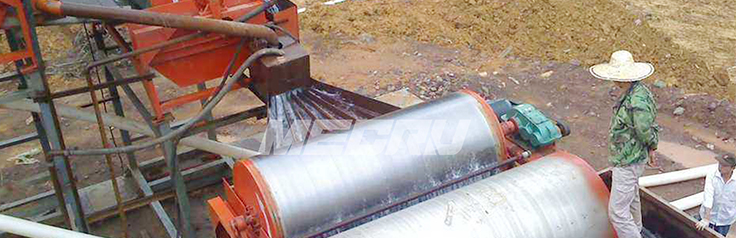
The ceramic filter is a new generation of high-efficiency, energy-saving solid-liquid separation equipment. Its operating principle is similar to that of a conventional disc vacuum filter; the key difference is the use of porous ceramic filter plates as the filtration medium. Due to capillary action, only water passes through the ceramic plates during filtration, while air is blocked; this causes solid particles to adhere to the surface of the ceramic plates, allowing the subsequent stages of "water extraction" and "drying" to proceed.

Energy-efficient and High-performance: Offers high processing capacity and significant energy savings. Processing capacity exceeds 1,100 kg/m²·h with power consumption under 0.5 kWh/t; compared to traditional disc or external-filtration machines, it reduces energy consumption by over 80%.

Fully Automated Control:High-performance models feature programmable automatic control, automatic feeding, and automatic cleaning, thereby reducing operator workload and staffing requirements.

Automatic Protection System:Equipped with automatic fault alarms, on-screen fault displays, and high/low liquid level monitoring; the system can automatically resolve issues or shut down to prevent damage.

Durable and Reliable:Designed using computer-aided optimization for a rational structure and reliable operation. Key drive components feature a maintenance-free design to minimize downtime caused by malfunctions, while the tank's agitation system utilizes specialized anti-corrosion materials, ensuring a service life of over 10 years.

Enhanced Product Quality: Produces concentrate with very low moisture content, significantly boosting market competitiveness while reducing transportation costs and losses during transit. Significant Environmental Benefits:Produces clear filtrate suitable for recycling, thereby reducing discharge and aligning with current trends toward cleaner production and environmental sustainability.
| model | Area per filter ring m² | Number of laps | Number of ceramic pieces per ring | Total number of ceramic panels | Total weight (kg) | Total power (kW) | Dimensions Length/Width/Height (mm) |
|---|---|---|---|---|---|---|---|
| ZPG-2 | 1 | 1 | 12 | 12 | 350 | 6 | 1580/2150/2150 |
| ZPG-4 | 2 | 2 | 12 | 24 | 1200 | 12.76 | 2100/2150/2150 |
| ZPG-6 | 2 | 3 | 12 | 36 | 1600 | 17.08 | 2350/2150/2150 |
| ZPG-8 | 2 | 4 | 12 | 48 | 2000 | 17.38 | 2600/2150/2150 |
| ZPG-12 | 3 | 4 | 12 | 48 | 3100 | 19.68 | 2860/2730/2340 |
| ZPG-15 | 3 | 5 | 12 | 60 | 4000 | 20.08 | 3160/2730/2340 |
| ZPG-24 | 3 | 8 | 12 | 96 | 7000 | 23.5 | 4060/2730/2486 |
| ZPG-30 | 5 | 6 | 12 | 72 | 9000 | 35 | 3480/2980/2580 |
| ZPG-40 | 5 | 8 | 12 | 96 | 10000 | 45 | 4080/2980/2580 |
| ZPG-45 | 5 | 9 | 12 | 108 | 10500 | 50 | 4380/2980/2580 |
| ZPG-50 | 5 | 10 | 12 | 120 | 11000 | 52 | 4830/3040/2910 |
| ZPG-60 | 5 | 12 | 12 | 144 | 11500 | 54 | 5490/3040/2910 |
| ZPG-80 | 5 | 16 | 12 | 192 | 12500 | 57 | 6690/3040/2910 |
| ZPG-96 | 6 | 16 | 12 | 208 | 13000 | 60 | 6690/3040/2950 |
| ZPG-100 | 5 | 20 | 12 | 240 | 14000 | 65 | 7290/3040/2950 |
| ZPG-120 | 6 | 20 | 12 | 240 | 16500 | 75 | 7960/3650/3198 |
Note:Any change of technical data shall not be advised additionally.


The ceramic filter consists of several discs, each composed of sector-shaped ceramic filter plates. These discs are mounted on a main shaft, which is driven by a motor via a speed reducer, gears, and a chain.
The discs rotate clockwise within the slurry tank. In the suction zone, the pressure difference created across the ceramic filter plates by a vacuum pump causes the slurry to adhere to the plates, forming a filter cake.
Simultaneously, an agitator operates with a reciprocating motion to prevent solid sedimentation. After the filter cake forms, the ceramic plates rotate into the drying zone, where moisture continues to be extracted. The filtrate drawn out during the process passes through the ceramic plates, filtrate pipes, the distribution head, and the vacuum tank before being discharged from the equipment.
Subsequently, as the ceramic plates pass through the discharge zone, a ceramic scraper removes the filter cake; the cake slides off both sides of the scraper into a hopper or onto a conveyor belt for transport to a designated location.
After the filter cake is discharged, the ceramic plates rotate to the backwashing position. Here, the flow direction is reversed relative to the vacuum suction, creating an outward flow that clears particles clogging the ceramic micropores before the plates are re-immersed in the slurry. After prolonged operation, a comprehensive shutdown cleaning of the ceramic filter plates can be performed. This process involves using a backwashing fluid—which may be supplemented with chemical agents—combined with ultrasonic oscillation to thoroughly clean the plates and maintain the filter's high operational efficiency.

The Australian customer has been cooperating with Mecru Heavy Industry for a long time, and this time he wants to add a ...
Read more
The customer's manganese ore is mainly produced by rhodochrosite and calcium rhodochrosite, followed by manganese c...
Read more

We promise that all your information will be kept confidential. Please be assured to complete these information. It is just for our sales manager to contact you accordingly.
Contact us for professional technical support by:
Copyright © 2004-2021 by Mecru Heavy Industry Technology Co., Ltd. Legal Notice 豫ICP备18029974号-2